If you have noticed a fold, bulge or ledge of tissue sitting above your caesarean scar, you may have heard it called a “C-section shelf” or “C-section pouch”. These are informal descriptions of an appearance, not medical diagnoses.
A shelf can look similar from the outside while reflecting different combinations of healing scar tissue, skin, fat distribution, swelling and abdominal-wall changes. That is why a photograph, mirror check or online label cannot tell you exactly what is contributing in your case.
This guide explains what the term usually means, what may shape the area and what you can realistically do without promising that one treatment will remove it.
What is a C-section shelf?
A C-section shelf describes tissue that appears to sit over or around a caesarean scar. Some women notice a small crease. Others see a more defined fold or overhang. It may be noticeable soon after birth, emerge as swelling settles, or remain visible long after the incision has healed.
The term does not explain what the tissue is made of or whether anything is wrong. A recent surgical paper uses related terms such as “caesarean apron”, pouch and shelf to describe changes in lower-abdominal contour involving skin and fatty tissue around the scar. The authors also discuss scar and abdominal-wall factors, but their proposed mechanism should not be treated as a diagnosis for every woman. [1]
It is also worth saying clearly: having a shelf does not mean you caused it, failed to recover properly or should feel pressured to change it.
Why can the area above a C-section scar look different?
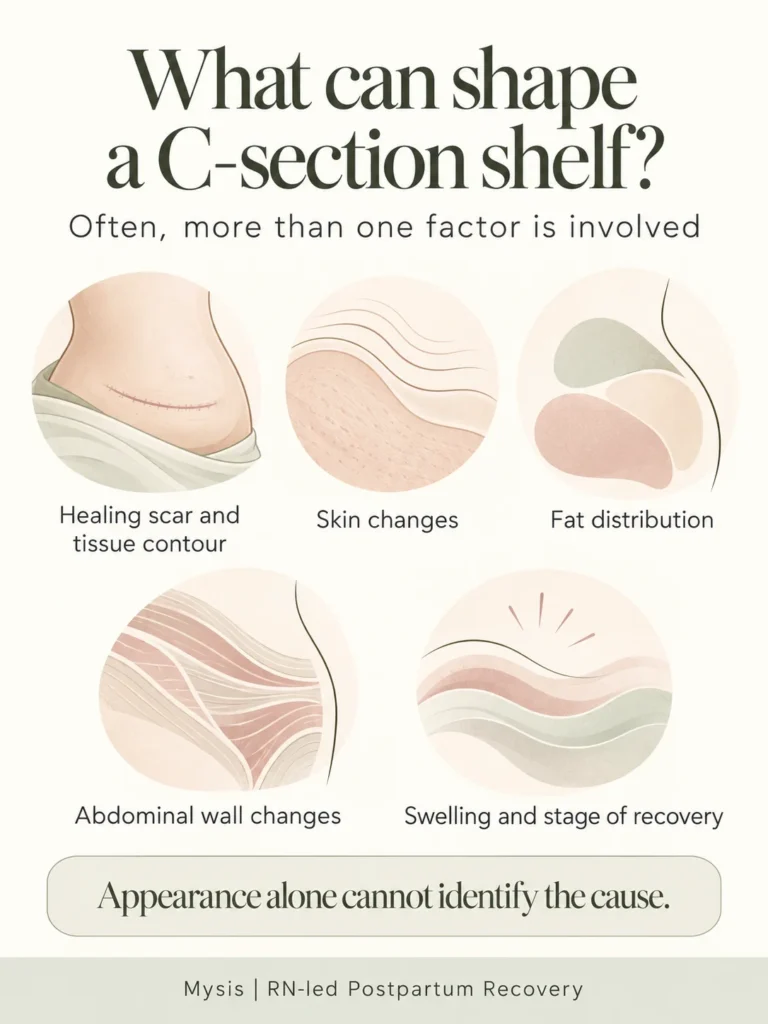
There is rarely one universal explanation. Several factors can overlap.
Healing scar and tissue contour
A caesarean incision heals through several tissue layers. As healing progresses, the scar and surrounding tissues may feel firmer, tighter or less mobile than nearby areas. This can influence how the skin and soft tissue sit, but scar restriction should not be assumed from appearance alone.
If your main concern is pulling or restricted movement rather than appearance, read why a C-section scar can feel tight.
Skin and fat distribution
Pregnancy stretches the skin and changes the shape of the abdomen. The amount and distribution of skin and fatty tissue also differ between individuals. These tissues may sit more visibly over a low horizontal scar, and this is not necessarily the same thing as a scar adhesion.
Abdominal-wall changes
The abdominal wall stretches during pregnancy. Some women also have ongoing abdominal separation, known as diastasis recti, or notice reduced abdominal strength and control after birth. These changes can influence the broader shape and function of the abdomen, but they do not explain every shelf. [4, 7, 8]
For a separate explanation of abdominal separation, read what diastasis recti is.
Swelling and stage of recovery
Early after a caesarean, swelling and normal post-surgical healing can temporarily change the area’s appearance. Recovery after a caesarean takes time, and Australian guidance notes that pain, altered sensation and wound changes can continue beyond the first few weeks. [2]
More than one factor at once
Skin, fat, scar tissue, swelling and abdominal-wall function are not mutually exclusive. More than one may contribute, and the balance may change over time. An individual assessment is more useful than assuming every shelf has the same cause.
Can you tell what is causing it by looking?
Not reliably. The same visible contour can have different contributors, and appearance alone cannot show how the scar moves, whether abdominal separation is present, or whether your concern is mainly cosmetic, sensory or functional.
A useful assessment may consider:
- how long it has been since your caesarean
- whether the wound is fully healed
- pain, sensitivity, numbness or pulling
- how the scar and surrounding tissue move
- abdominal-wall function and any doming or bulging
- how the area responds during everyday movement
- your own priorities and whether the appearance concerns you
If a shelf is not painful or affecting function, you do not have to treat it. Wanting an assessment is also reasonable if you would like to understand the area better.
What a Mysis assessment may consider
Once the incision has healed and there are no wound concerns requiring medical review, a Mysis RN-led postpartum assessment may consider how the area feels and functions as well as how it looks. This may include scar comfort and sensitivity, how the healed scar and nearby tissue move, how your abdomen responds during everyday movement, and any broader abdominal-recovery concerns you would like to discuss. [6, 7, 8]
This does not mean that appearance alone can identify the cause of a shelf, or that scar care will remove it. Mysis does not replace assessment by your GP, obstetric team or pelvic-health physiotherapist. Wound problems, a new or changing bulge, significant or worsening pain, or concerns requiring diagnosis should be referred to an appropriate clinician. A pelvic-health physiotherapist may be particularly useful when abdominal-wall function, doming, exercise progression or pelvic-floor symptoms need detailed assessment.
A Real Mysis Client Case: Lower-Abdominal Contour
This Mysis client received personalised postpartum care, including abdominal massage and belly binding.
The photographs show a visible difference in her lower-abdominal contour, particularly around the area above her C-section scar.
At Mysis, we take an individual approach to postpartum recovery, considering scar comfort, tissue mobility and abdominal function rather than focusing on appearance alone.
This is one client’s experience. Photography conditions differ, and the images do not establish treatment effectiveness or guarantee similar results.
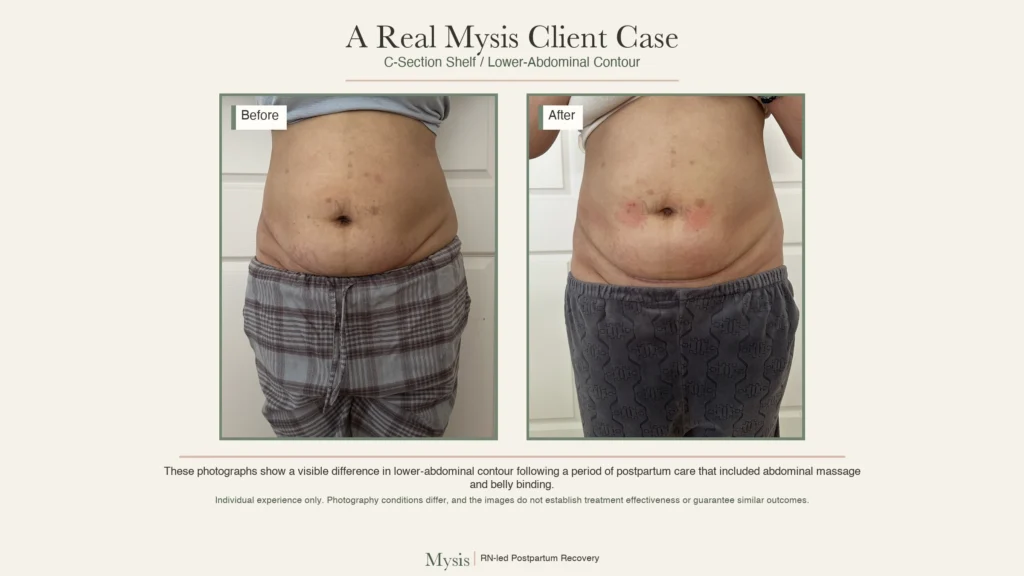
Real Mysis client. The photographs are authentic but not standardised: clothing, arm position, framing, camera distance and possibly posture and angle differ. The comparison does not establish that care caused the visible difference or predict another person’s outcome.
What can you realistically do?
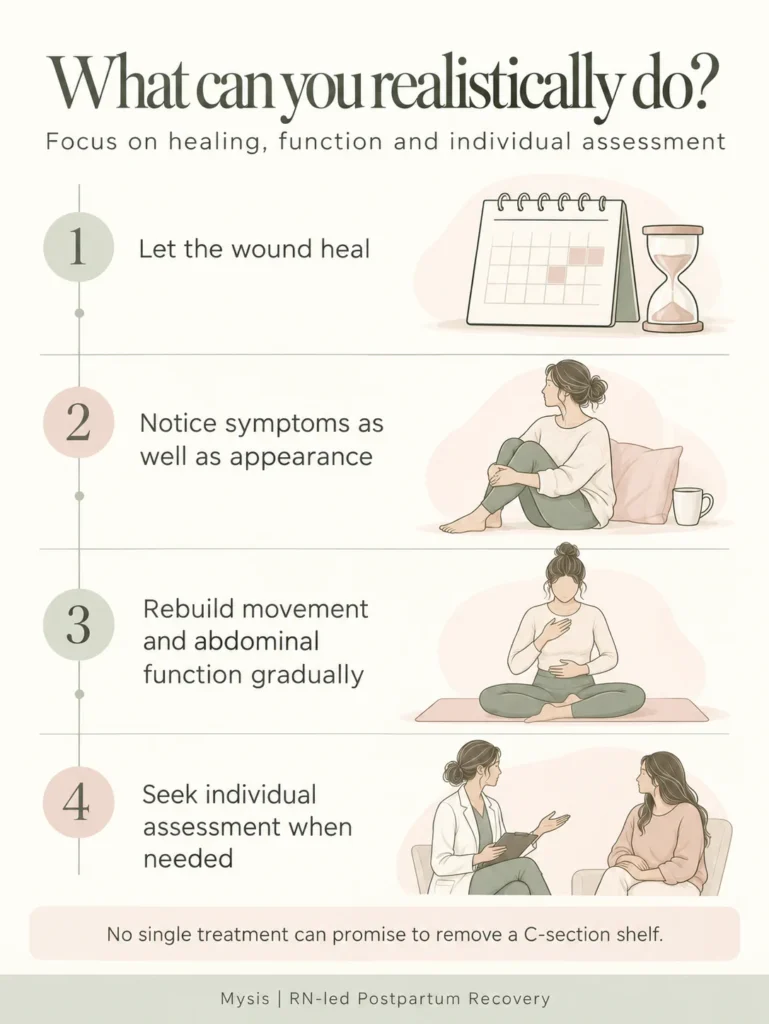
Let the wound heal first
If your caesarean is recent, wound healing comes before massage or appearance-focused treatment. Keep the wound clean and dry as advised, follow your maternity team’s instructions and seek medical review for increasing redness, swelling, pain, discharge, wound opening, fever or feeling unwell. [2, 3]
Give recovery time
The area can change as swelling settles and tissues heal. There is no single date by which your abdomen should reach its final shape. Comparing an early postpartum body with someone else’s later recovery is unlikely to tell you what yours will do.
Rebuild movement and abdominal function gradually
Gentle walking and a gradual return to movement are commonly recommended after caesarean birth, adjusted to your symptoms and clinical advice. [2, 4] If you notice doming, difficulty managing pressure, persistent weakness or uncertainty about exercise, a women’s or pelvic-health physiotherapist can assess function and guide an individual progression.
Exercise can support strength, movement and general health, but current evidence does not establish exercise as a way to remove a C-section shelf or predict a particular cosmetic change.
Consider scar care only when the wound is ready
Direct scar massage should wait until the incision is fully healed and a suitable health professional has confirmed it is appropriate. Scar care may focus on comfort, sensitivity and mobility. Evidence does not justify promising that massage will remove a C-section shelf or produce a particular cosmetic result.
For timing and safety details, see when C-section scar massage may be appropriate.
Seek assessment when symptoms persist
Consider speaking with your GP, obstetric clinician or pelvic-health physiotherapist if you have persistent pain, significant pulling, a new or changing bulge, concerns about abdominal-wall function, or uncertainty about what you are seeing. An assessment can help separate wound or scar concerns from broader abdominal-wall changes and identify whether referral is needed.
What treatments cannot promise
Be cautious with claims that one massage technique, exercise programme, cream, binder or device can “break down” scar tissue, melt local fat or guarantee a flat lower abdomen.
Different tissues respond differently. Some approaches may support comfort, movement or confidence for a suitable person, but that is not the same as proving they will remove a shelf. If your main goal is a cosmetic change, say so openly when seeking advice so that the limits, risks and realistic options can be discussed clearly.
When to seek medical advice
Contact your maternity service, midwife, GP or another appropriate clinician promptly if your wound becomes increasingly red, swollen, hot or painful; starts opening; produces discharge or a bad smell; or if you develop a fever or feel unwell. [2, 3]
The realistic bottom line
A C-section shelf is a description of shape, not a diagnosis. Scar and tissue contour may contribute, but so can skin, fat distribution, swelling and abdominal-wall changes.
You do not need to “fix” the area simply because it looks different after birth. If it is painful, restrictive, changing or important to you, the most useful next step is an individual assessment that considers healing, symptoms and function rather than offering a guaranteed cosmetic solution.
For an overview of Mysis support in this area, visit C-section scar care.
Want personalised support for your C-section recovery?
Changes around a caesarean scar can involve more than appearance alone. Mysis offers RN-led postpartum recovery home visits across Sydney, with personalised support that may include C-section scar care, abdominal recovery guidance and practical education suited to your stage of healing.
If your incision has healed and you would like help understanding scar comfort, mobility or broader abdominal recovery, get in touch to discuss your next step.
* Individual results may vary and do not replace medical advice.
C-Section Shelf or Pouch FAQs
Is a C-section shelf normal?
It is a commonly used description for tissue sitting above or around a caesarean scar. It does not by itself mean that something is wrong, but a new, painful or changing bulge should be assessed rather than labelled from appearance alone.
Is a C-section pouch scar tissue or fat?
It may involve a combination of scar and tissue contour, skin, fat distribution, swelling and abdominal-wall changes. You cannot reliably identify the main contributor just by looking at it.
Will a C-section shelf go away on its own?
The area may change as swelling settles and tissues heal, but there is no reliable way to promise whether a shelf will disappear or how long change will take. The outcome depends on what is contributing for you.
Can scar massage remove a C-section shelf?
Scar care may support comfort, sensitivity or tissue mobility once the wound is fully healed and a suitable health professional has confirmed it is safe. It should not be promoted as a guaranteed way to remove a shelf. Read when C-section scar massage may be appropriate.
Can diastasis recti cause a C-section shelf?
Abdominal separation can influence the shape and function of the abdomen, but it does not explain every shelf. Skin, fat distribution, swelling and scar-related contour may also contribute. Learn more about diastasis recti after pregnancy.
Sources
- Pelosi MA II, Pelosi MA III, Romero R. The cesarean apron: description, proposed pathophysiology, classification, and prevention through Scarpa fascia closure at cesarean delivery. American Journal of Obstetrics & Gynecology, 2026. This is an emerging surgical paper; its proposed mechanisms are not treated as a universal diagnosis.
- Pregnancy, Birth and Baby. Recovery after a caesarean. Australian Government-supported national information service. Last reviewed December 2025.
- The Royal Women’s Hospital. Going home after a caesarean section. December 2024.
- The Royal Women’s Hospital. Exercise after birth.
- Healthdirect Australia. Caring for stitches (sutures).
- Kingston and Richmond NHS Foundation Trust. Scar massage after caesarean birth. Used only for cautious scar-massage readiness and technique context; it does not establish cosmetic shelf removal.
- Northern Sydney Local Health District. Postnatal Physiotherapy Information Booklet. Used for postpartum abdominal recovery, graduated strengthening and women’s-health physiotherapy referral context.
- Song MSH, et al. Management of postpartum rectus diastasis in primary care. British Journal of General Practice, 2026. Used for symptom- and function-led abdominal-wall assessment; it is not evidence that diastasis causes every C-section shelf.
- NSW Health. Postnatal care: adult state-wide referral criteria. Used for current postnatal emergency and referral indicators.
This article provides general education and does not replace individual medical advice.