
During pregnancy, preparation often centres on labour, feeding and everything the baby might need. Your own recovery can easily become an afterthought.
Preparing for postpartum recovery does not mean trying to predict exactly how your birth will unfold. It means arranging practical support, reliable health contacts and a home environment that asks less of you during the first weeks.
Recovery differs from one person to another. Your birth experience, health and any complications will affect the advice and support that are appropriate for you. This guide provides general educational information and does not replace advice from your midwife, maternity team, GP or other treating health professional.
Make a flexible recovery plan
Your eventual birth and recovery may differ from what you expect. A plan that allows for vaginal, assisted or caesarean birth is likely to be more useful than one built around a single outcome.
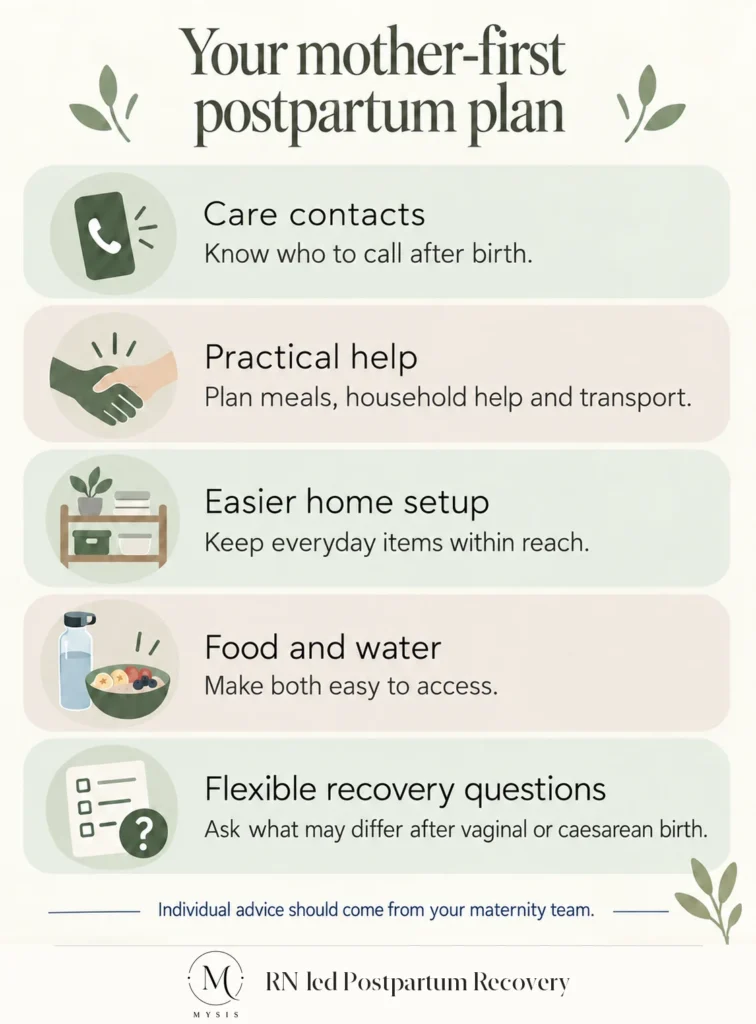
Start with a few practical foundations:
– Know who to contact after leaving hospital.
– Arrange help at home.
– Make food, water and everyday supplies easy to reach.
– Reduce tasks involving lifting, carrying or repeated trips around the house.
– Ask what advice may differ after vaginal or caesarean birth.
– Know where to seek help if you are concerned.
Australian guidance notes that the type of labour and birth affects recovery, which may take six weeks or longer.[^1] This is a general guide, not a deadline your body must meet.
Know who you can contact
Before your baby arrives, save the contact details you may need after birth. Depending on your care arrangements, these may include:
– your maternity unit or hospital
– your midwife
– your GP
– your local child and family health service
– breastfeeding or lactation support
– a pelvic-health physiotherapist, if recommended
– mental-health support
– Healthdirect
– emergency services
Ask your maternity team what follow-up you can expect and whether you need to arrange any appointments yourself. Arrangements can differ between hospitals and individual models of care.[^2]
Useful questions include:
– Who should I call if I have concerns after going home?
– Will a midwife or child and family health nurse contact me?
– What wound, perineal or activity advice applies to my birth?
– Which symptoms require prompt medical advice?
– What does the hospital provide for my recovery?
– What should I bring for myself?
Keep the answers somewhere your main support person can find them too.
Decide what help at home will look like
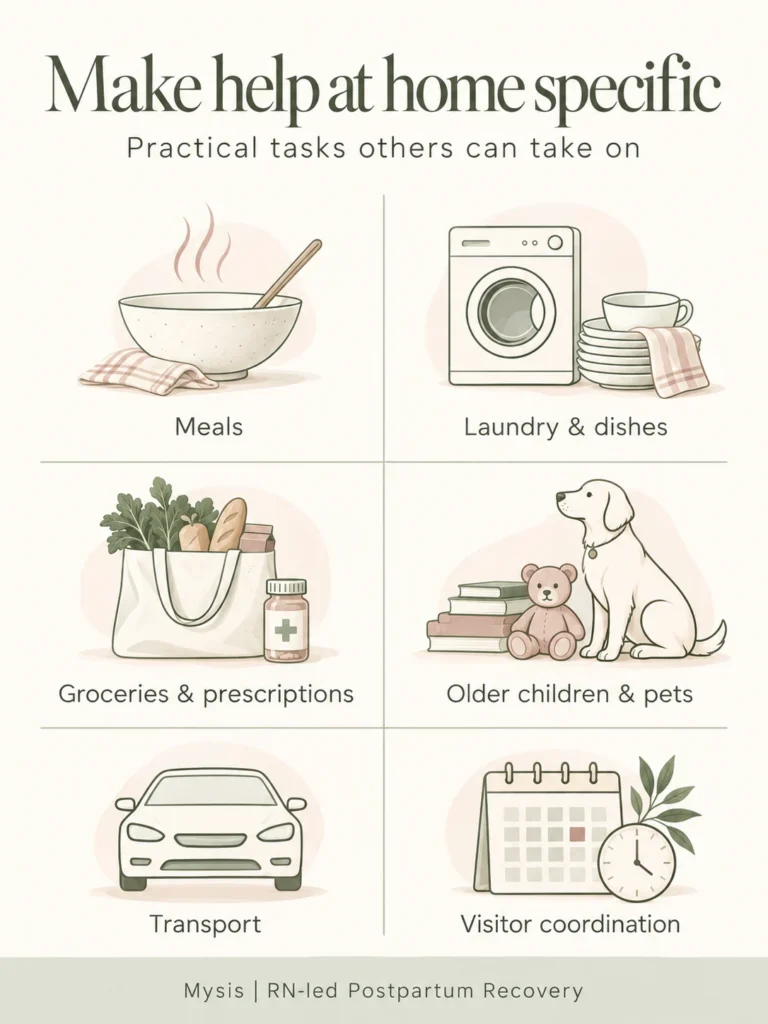
Offers of help are easier to use when they are specific.
Before birth, consider who could:
– prepare a meal
– wash dishes or clothes
– shop or collect prescriptions
– care for older children
– help with pets
– drive you to an appointment
– refill water and snacks
– manage visitors
– take on suitable baby-care tasks while you rest
Pregnancy Birth and Baby recommends planning for help with meals, household tasks and baby care, and setting visitor limits according to your family’s needs.[^2]
If relatives are not nearby, several people may each be able to take one small responsibility. You might also discuss partner leave, grocery delivery, transport and any paid household support you want to arrange.
The purpose is to reduce the number of decisions and physical tasks resting on you while you recover.
Prepare your home for easier recovery
You do not need an elaborate recovery kit. A few changes can make everyday items and tasks easier to manage.
Put frequently used items within reach
Consider setting up a simple area in the bedroom, bathroom and wherever you expect to spend time resting or feeding your baby.
Depending on your needs, you might keep these items nearby:
– water
– easy-to-eat snacks
– a phone charger
– tissues
– basic hygiene supplies
– feeding supplies
– medicines recommended for you, stored safely
– somewhere to record questions for your healthcare team
Choose what suits your home, preferences and expected care needs. Specially marketed postpartum products are not automatically necessary.
Review movement around your home
Notice tasks that may involve extra effort:
– repeated trips up and down stairs
– getting out of a low chair or bed
– bending to reach everyday items
– carrying laundry, groceries or a toddler
– moving supplies between rooms
– walking through cluttered areas
Australian public-hospital resources provide birth-specific advice about mobility, getting out of bed and lifting after birth.[^3][^4] Follow the instructions given for your own birth and recovery.
Beforehand, move frequently used items to accessible places and decide who can take over heavier household tasks.
Prepare easy food and water access
Prepare a small selection of meals you already enjoy, or arrange help with cooking and groceries. Keep water and simple snacks where you expect to rest or feed your baby.
There is no need to follow a perfect postpartum diet. Focus on access to food and fluids that suit your preferences, health needs and cultural practices. Seek individual advice if a health condition affects what you should eat or drink.
Prepare for more than one kind of physical recovery
After birth, some women experience vaginal bleeding, cramping, perineal soreness, caesarean wound discomfort, breast or feeding-related discomfort, fatigue, and changes in bladder or bowel function.[^1][^5]
What you experience and how long it lasts will vary.
Ask your maternity team what supplies they recommend, how to care for any wound or stitches, and which changes should prompt a call. Detailed care instructions should come from the clinicians who know your birth and medical history.
Try not to give yourself a deadline for feeling recovered. Needing more time or support does not mean that you prepared badly.
Ask how to balance rest and movement
Australian professional and hospital guidance generally recommends a gradual return to movement, adjusted for the birth, symptoms and individual clinical advice. [3, 6]
Before leaving hospital, ask:
- How should I get in and out of bed comfortably?
- Are there lifting or movement restrictions for me?
- What symptoms should make me stop and seek advice?
- When should I discuss returning to exercise?
- Would an individual pelvic-floor or physiotherapy assessment be appropriate?
A general online guide cannot prescribe the exercises, repetitions or timeline that are right for your body.
For more detailed information, read about abdominal recovery after birth and core and breathing recovery. If you have had a caesarean birth, Mysis also has separate information about C-section scar care. Your treating clinician remains the appropriate source for immediate wound care, medical clearance and individual rehabilitation advice.
Include emotional support in the plan
Choose someone you can speak to honestly after birth. Discuss how you would like them to respond if you feel overwhelmed, struggle to cope or find it hard to ask for help.
Save your GP’s details and relevant support numbers. If your mood or ability to cope concerns you, seek professional help rather than waiting for a scheduled check-up. [1, 7]
Visitor boundaries can also help. You can keep visits short, postpone them or ask visitors to contribute practical help.
Your mother-first preparation checklist
Before your baby arrives:
- Confirm your post-discharge contacts.
- Ask what follow-up you will receive.
- Write down questions for your maternity team.
- Arrange help with meals and household tasks.
- Decide how visitors will be managed.
- Organise support for older children or pets.
- Place everyday items within easy reach.
- Reduce avoidable lifting and carrying.
- Prepare for vaginal and caesarean recovery possibilities.
- Ask for advice specific to your birth and health.
- Know where to seek help if you are concerned.
You do not need to anticipate every experience. The aim is to leave fewer practical decisions for the period when you are recovering and caring for your baby.
When to seek medical help
Contact your maternity service, midwife or GP straight away if you have a fever, bleeding that becomes heavier or smells unusual, problems with a wound or stitches, leg pain, difficulty passing or controlling urine, or difficulty coping.
Seek immediate medical care if you feel unwell and have chest pain, sudden heavy bleeding, breathing difficulty, a severe headache, blurred vision, vomiting, or pain, swelling or redness in the calf of one leg.
Call triple zero on 000 or go to an emergency department for a serious or urgent medical problem. If you are unsure what level of care you need, call Healthdirect on 1800 022 222. If you or someone you know is having suicidal thoughts and is in immediate danger, call 000.
This is not an exhaustive list. Follow the individual safety and discharge advice provided by your maternity team.
Sources
- Pregnancy Birth and Baby, Looking after your body after having a baby
- Pregnancy Birth and Baby, Being at home with your baby after giving birth
- Sydney Local Health District, Postnatal Resource Booklet
- King Edward Memorial Hospital, Your caesarean birth and recovery
- Pregnancy Birth and Baby, Your first few days after giving birth
- Royal Australian and New Zealand College of Obstetricians and Gynaecologists, The First Few Weeks Following Birth
- Healthdirect Australia, Postnatal depression
- NSW Health, Postnatal care
- Healthdirect Australia, Hospital emergency departments
FAQ
What should I prepare for myself before giving birth?
Start with practical support rather than products. Confirm who you will contact after discharge, arrange help with meals and household tasks, place everyday items within reach and ask your maternity team what may be needed after vaginal or caesarean birth.
How can my partner or family help after birth?
Useful help is specific and practical. It might include preparing food, managing laundry and visitors, caring for older children, collecting prescriptions, helping with transport or taking on suitable baby-care tasks while you rest.
What if I do not have family nearby?
Ask several people for small, defined forms of help rather than relying on one person. You can also consider partner leave, food delivery, transport, household help and the health or community services available in your area.
How should I prepare if I do not know whether I will have a vaginal or caesarean birth?
Build a foundation that works for either: support contacts, accessible food and supplies, and help with physical tasks. Ask your maternity team what wound care, movement advice and recovery items would differ.
Does everyone need professional postpartum support?
No. Some mothers have the support they need through family, friends and their healthcare team. Others consider additional support based on their recovery, preferences and circumstances.
Your Recovery Matters Too
As you prepare to welcome your baby, remember that your own recovery deserves just as much care and attention.
At Mysis, we provide RN-led postpartum recovery home visits across Sydney, combining traditional belly binding with personalised recovery support based on your individual needs.
Not sure when to start or which plan may suit you? Get in touch to discuss your postpartum recovery options.
* Individual results may vary and do not replace medical advice.