Can Diastasis Recti Heal Years After Giving Birth?
If you gave birth several years ago and still notice abdominal separation, tummy bulging or difficulty reconnecting with your core, you may wonder whether it is simply “too late” to do anything about it.
The short answer is:
No — it is not necessarily too late.
Diastasis Recti does not have a strict recovery deadline. While natural recovery often occurs during the early postpartum months, abdominal function may still improve with appropriate rehabilitation and progressive exercise later in life.
The goal is not always simply to “close the gap”. It is also about improving how your abdominal wall supports, controls pressure and works during everyday movement.
Does Diastasis Recti Heal Naturally After Birth?
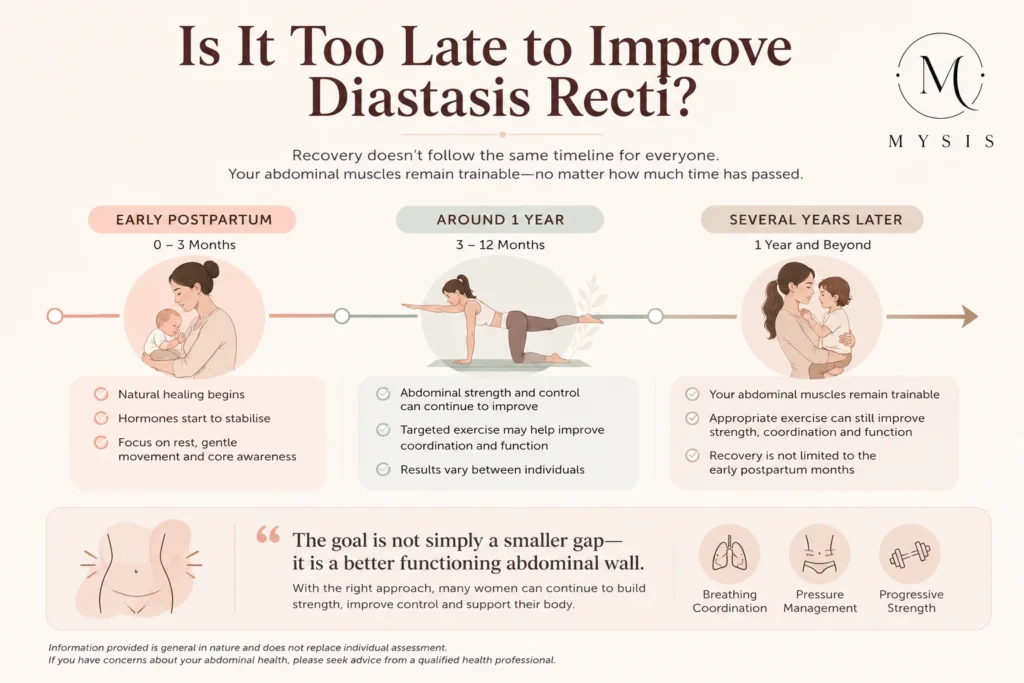
For many mothers, some natural recovery occurs during the first months after pregnancy.
As the abdominal wall recovers, the distance between the rectus abdominal muscles may gradually reduce.
However, recovery varies significantly between individuals.
Some women continue to notice abdominal separation, tummy bulging or changes in abdominal function months or even years after giving birth.
Persistent Diastasis Recti does not automatically mean that nothing can be done.
Is It Too Late to Improve Diastasis Recti Years Later?
Not necessarily.
Even if your youngest child is several years old, your abdominal muscles can still be trained.
Exercise-based rehabilitation may help improve abdominal strength, coordination and function.
There is currently no single exercise programme proven to be best for every woman, and much of the existing research focuses on the earlier postpartum period.
For this reason, recovery should be approached individually rather than based only on how long ago you gave birth.
Time since pregnancy is only one part of the picture.
Why Might Diastasis Recti Still Be Present?
There is rarely one single reason.
Several factors may influence abdominal wall recovery, including:
✓ Multiple pregnancies
✓ Individual differences in connective tissue and healing
✓ Reduced abdominal strength or coordination
✓ Difficulty coordinating breathing and abdominal activation during movement
✓ Poor pressure management during lifting or exercise
✓ Returning to exercise without appropriate progression
✓ Ongoing doming or bulging during certain movements
For some women, the width of the abdominal gap is only one part of the concern.
How the abdominal wall responds during movement may also affect how the abdomen looks and functions.
What Can Help Improve Diastasis Recti Years Later?
There is no single exercise or treatment that works for everyone.
A more individualised recovery approach may include:
1. Progressive Core Exercise
Appropriate abdominal exercise may help improve abdominal strength, coordination and abdominal wall function.
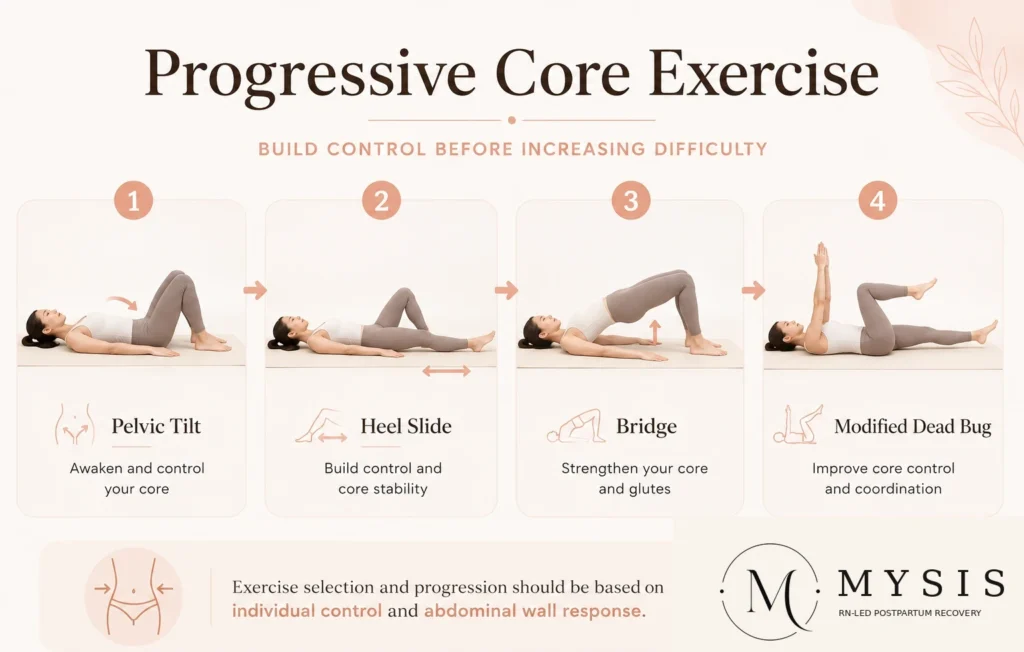
Depending on individual ability and abdominal control, exercise programmes may include movements such as:
✓ Pelvic tilts
✓ Heel slides
✓ Controlled abdominal activation exercises
✓ Marching exercises
✓ Bridges
As strength and control improve, exercises may progress to more challenging abdominal movements, including modified dead bugs or appropriately performed curl-ups.
There is no single “best” exercise for Diastasis Recti. Exercise selection and progression should consider individual symptoms, abdominal control and how the abdominal wall responds during movement.
2. Breathing and Pressure Management
Breathing and abdominal muscle activity work together during movement.
Learning to coordinate breathing with abdominal activation may help improve pressure management when lifting, exercising or carrying your baby.
The goal is not to constantly hold your stomach in.
3. Deep Core Coordination
The deeper abdominal muscles contribute to abdominal wall control.
However, Diastasis Recti recovery is not simply about activating one muscle.
The goal is to improve coordination between breathing, the abdominal wall and movement.
4. Belly Binding as Additional Support
Belly binding may provide external abdominal support and body awareness for some women.
However, it should not be considered a stand-alone treatment for Diastasis Recti.
At Mysis, belly binding is used alongside breathing, core activation and movement strategies as part of a broader postpartum recovery approach.
When Should You Consider an Assessment?
You may consider further assessment if:
✓ Your tummy still bulges years after pregnancy
✓ You notice doming when sitting up or exercising
✓ You struggle to engage your core
✓ Your abdomen fatigues during everyday activities
✓ You are unsure whether your abdominal wall is recovering well
An assessment can help identify whether abdominal wall control, breathing coordination, pressure management or other factors may need further attention.
Frequently Asked Questions
Can Diastasis Recti improve 5 or 10 years after pregnancy?
There is no strict postpartum deadline after which abdominal rehabilitation becomes impossible.
The abdominal muscles remain trainable, and appropriate exercise may help improve strength, coordination and function.
Does exercise completely close Diastasis Recti?
Not always.
Exercise may improve abdominal function and may reduce the distance between the abdominal muscles in some women.
Results vary between individuals.
Is a wider gap always worse?
No.
Gap width is only one part of Diastasis Recti assessment.
Abdominal wall control, tension, symptoms and function should also be considered.
Still Concerned About Your Core Years After Giving Birth?
Our RN-led postpartum assessment looks beyond finger width alone and considers breathing patterns, abdominal wall control, core activation and overall recovery.
✔ RN-led Postpartum Recovery
✔ Personalised Assessment
✔ Home Visits Across Sydney
* Individual results may vary and do not replace medical advice.